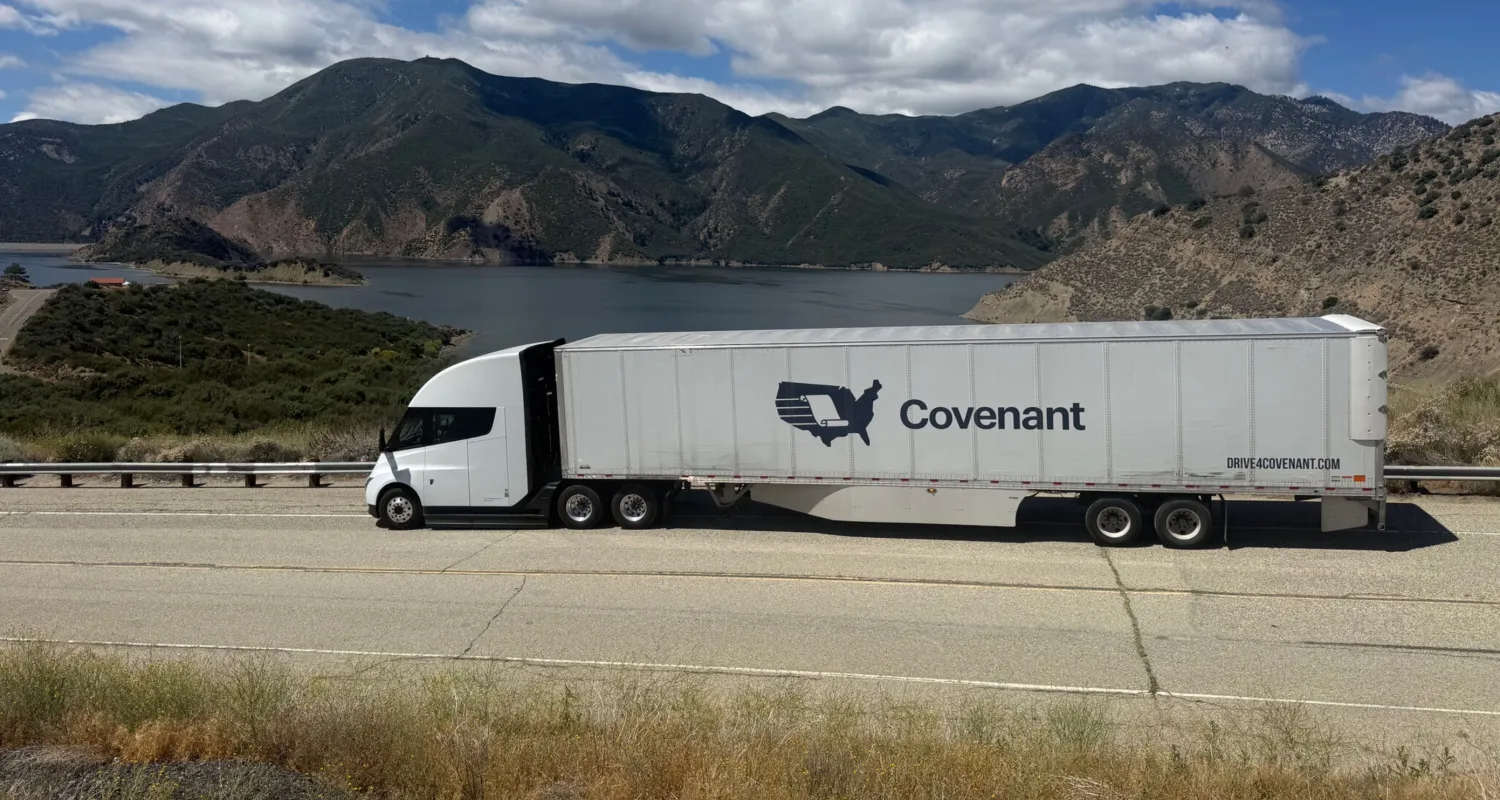
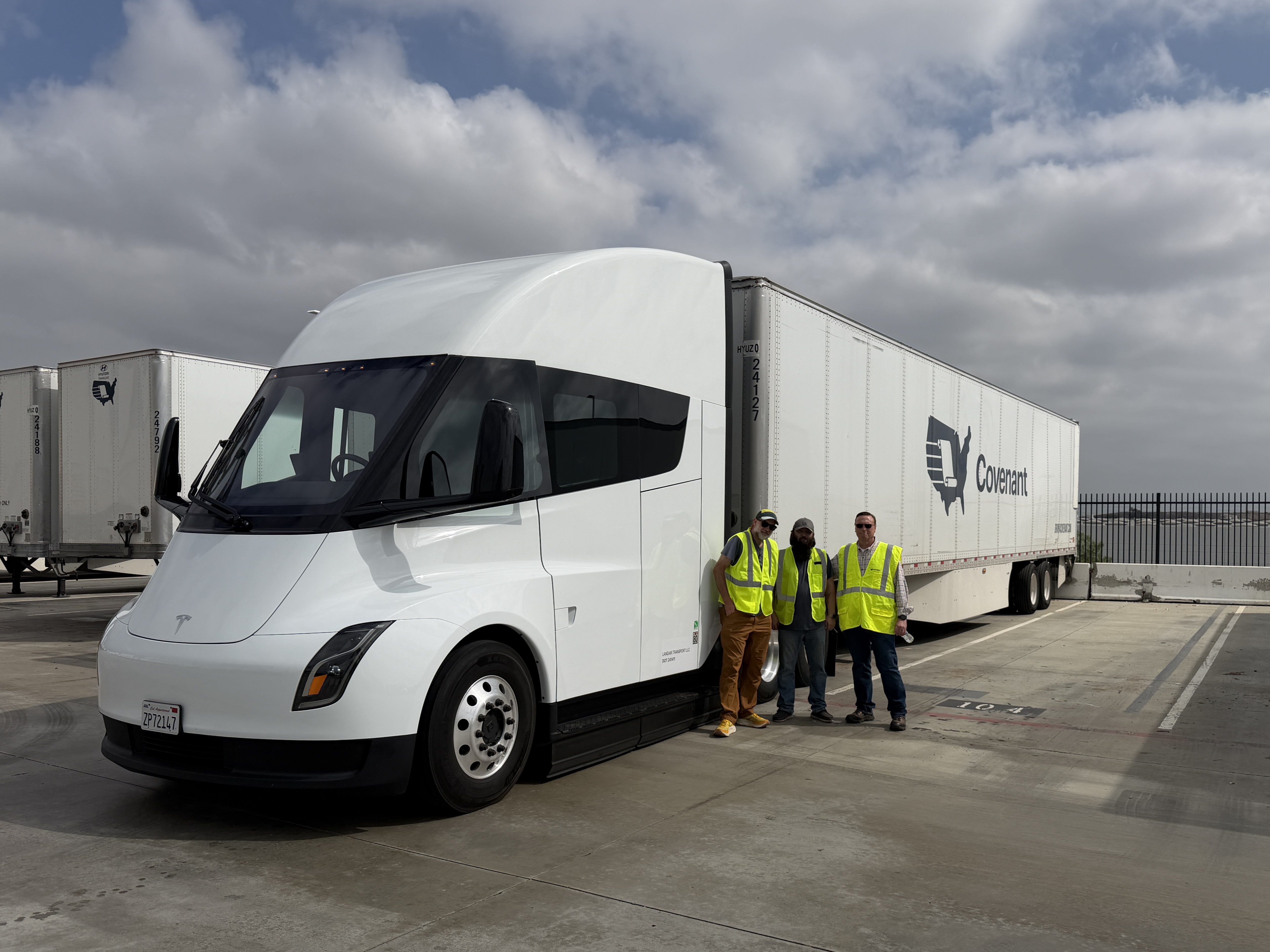
At Covenant Logistics, innovation is not a talking point. It is a discipline we build into how we evaluate every piece of equipment that could shape the future of our fleet. That discipline was on full display this spring when Covenant completed a three-week evaluation of the Tesla Semi in California, culminating in a loaded run over the Grapevine Pass, one of the most demanding stretches of highway in the country.
Why the Grapevine
For anyone who has driven I-5 through the Tejon Pass, the Grapevine needs no introduction. Sitting at 4,160 feet, it is the highest point on I-5 in California and a critical corridor for freight moving out of the ports of Oakland, Los Angeles, and Long Beach. The northbound descent drops 2,613 feet over 11.6 miles, with a five-mile stretch holding a 6 percent grade. It is the kind of climb and descent that tests a truck, and a driver, in ways a flat interstate never will.
That is exactly why Covenant chose it. If a truck can perform on the Grapevine with a full load, it can perform almost anywhere in our network.
What We Found
Working alongside one of our larger customers in California, Covenant put the Tesla Semi through two weeks of real-world duty before sending it up and over the pass fully loaded. The results were clear.
“The driver was amazed at the performance of the Tesla Semi and felt a level of confidence that was hard to match in a diesel truck,” said Matt McLelland, Covenant's VP of Sustainability and Innovation.
.jpg)
On the climb, the difference was immediate. A loaded diesel engine can bog down on a sustained grade, and once a truck loses momentum, regaining it takes time and fuel. The Tesla Semi's tri-motor powertrain delivers instant, continuous torque, so instead of the gradual, gear-shifting deceleration drivers expect on a climb like this, our test driver held speed with a consistency a diesel truck simply cannot offer.
On the descent, the advantage flips into something even more significant. A loaded truck coming down a sustained 6 percent grade puts real stress on a diesel fleet's friction brakes, and thermal management becomes the driver's full-time job for those five miles. The Tesla Semi handles it differently.
“That isn't a problem for an EV when you've got regenerative braking doing most of the work,” McLelland said.
Regenerative braking is more than a technical feature. On a grade like the Grapevine, it means the truck recovers energy instead of burning through brake pads, and it removes the risk of brake fade on a long downhill run. For a fleet that moves freight across this corridor regularly, that is not an incremental improvement. It is a meaningful operational advantage.
There is a driver experience benefit here too. Long haul mountain driving is one of the more demanding parts of the job, and managing gear ratios on a climb or watching for runaway truck ramps on a descent takes real focus even from experienced operators. Replacing that noise, vibration, and thermal throttling with the quiet, predictable feel of an electric powertrain is a meaningful change for the person behind the wheel, not just for the freight in the trailer.
A Measured Approach to Innovation
Covenant's evaluation of the Tesla Semi reflects the same approach we bring to every investment in our fleet: test it where it matters, under real conditions, with real freight. We are not interested in demonstrations built for a controlled environment. We are interested in how a truck performs on the roads our drivers run every day, carrying the loads our customers depend on us to deliver.
This evaluation is part of a broader pattern across the industry. Fleet operators across other leading logistics companies have put the Tesla Semi through similar real-world trials since volume production began, and the results across different routes, cargo types, and operators are building a consistent picture. Covenant is proud to be part of that body of evidence, and to bring our own scale and operational rigor to the conversation.
Looking Ahead
Sustainable progress at Covenant means more than reducing emissions. It means building a fleet that is safer, more capable, and more efficient for the drivers and customers who depend on us. The Grapevine evaluation is one data point in a much longer commitment to exploring what is next for our industry, without compromising the reliability our customers expect today.